
WTF is "community energy"?
And does Ed Miliband even know what a "community" is?

The word ‘billion’ falls out of politicians’ mouths so easily these days it might just as well be punctuation. It’s as if politicians do not feel they have said anything if they have not committed some number of billions to some policy or other. This week, among other billions, one billion pounds were committed to something called “community energy”. The Department for Energy Security and Net Zero proudly announced on Monday, the “biggest ever public investment in community energy will cut bills and create revenue for community centres, social clubs and places of worship”.
Granted, it’s not a hill of beans all by itself, but every time a politician commits £1 billion to something, it costs on average £35 per household. If there was such a thing as a “community” worthy of the term, surely the least that it would have within its means is to raise its own funds. What is a “community” if it is not defined by its capacity to act in such a way? Furthermore, what is a “community” if the £35 is to be taken as tax from households, to be given to the “community”? The word is uttered as glibly as ‘billion’ and ‘climate crisis’.
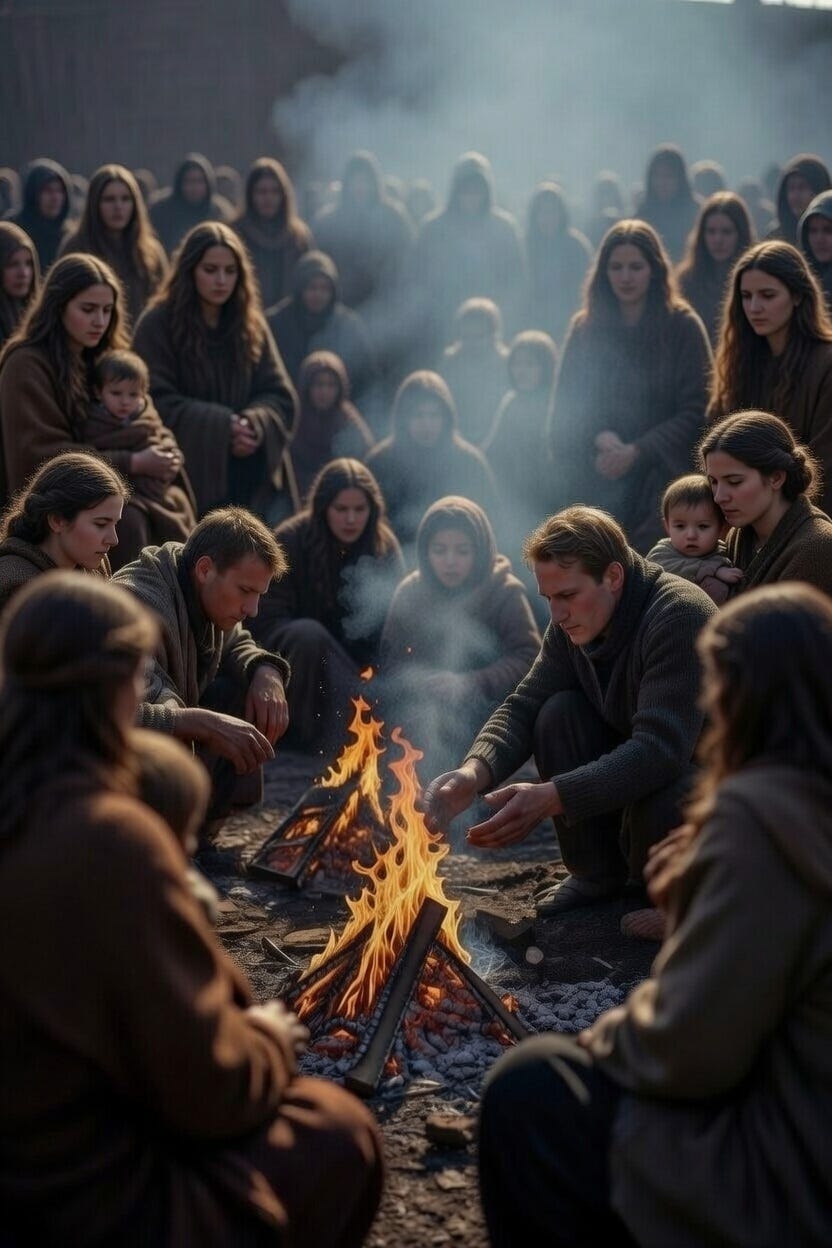
What Net Zero “community energy” is likely to look like.
It was Ed Miliband who reveals the true depth of bonkers: “By giving local people the chance to take control of their energy, this Government is making a fundamental choice to transfer wealth and power back to communities across Britain.” What does “take control of their energy” even mean? What is the virtue, the benefit?
I do not want to “take control” of my energy. I want a utility company to provide wires to my house and supply power through them at a reasonable price. This ability was mastered, and in many cases pioneered, by earlier generations of British engineers and properly socialised bureaucrats, in a project that spanned the middle half of the 20th century. Under national and private ownership, current flowed throughout the grid (once it was built) at a few pennies per kilowatt hour, sustained by skilled technicians, managers committed to the country’s interests and the needs of millions of homes and businesses. It was a division of labour of which perhaps only earlier generations could see the benefits: those who grew up with it soon took it for granted.
I do not want to “take control” of my energy because I have better things to do. Equally, I do not want to take control of my water supply. I do not want to grow my own food. I do not want to produce my own gas in any greater quantities than I am unfortunately committed to. I do not want to make, or even particularly mend, my own car. If I could avoid it, I wouldn’t even cook my own food – I’d go out. Other people can do these things far better than I can, more quickly. And if I value my time, then they can do these things more cheaply than I can too.
In exactly the same way, a “community” that “takes control of its energy” by accepting a Government grant now has to take on work that it cannot execute any more expertly than existing providers. It is now responsible for the maintenance and liabilities of the installed hardware. So, whereas some aspect of the wider fleet of generators and distribution might require a few hundred people to manage, each community now needs the labour of the individuals daft enough to volunteer for such a thing.
If there were any benefit to the concept of “community energy” over the division of labour made possible by the market, then “communities” would already be doing it, without the need of the billion pounds being made available in grants, taken as taxes from the members of ‘communities’. The state or private sector would have never built the generators and grid.
There are exceptions. I know of one “community energy” project. But it was precisely the kind of place one would imagine such a thing to happen: insufferably woke and populated by people with substantial or private incomes, living in near-million pound houses. Like Tom and Barbara from The Good Life, they LARP as ‘self-sufficient’, but it is, like allotment-keeping, merely a hobby, not economic, and is adjacent to virtue-signalling. The reality of their situation is that they can afford it. And the reality of their preoccupation with The Good Life is that it evinces a disgust for the modes of production that make a passably-decent decent life possible for the rest of the population. It’s much easier to find problems with industry and capitalism when you enjoy their benefits but are completely removed from life’s realities.
The notion that there are better ways to do things by changing the basis of ownership has long been the conceit of Lefties, of course. But much of the working class has, ultimately, shrugged at the idea of owning, let alone seizing, the means of production, leaving only categorically bourgeois Leftoids styling themselves as ‘the masses’. And that gives us a clue as to what is going on here.
In the Department of Energy and Net Zero (DESNZ) press release, Great British Energy CEO Dan McGrail said: “Communities are at the heart of Great British Energy’s mission,” and that “local and community projects create cleaner, more secure and more affordable energy for our communities”. Communities. Communities. Communities. Perhaps he didn’t think he’d said it enough. But finally, it came: “We are investing up to £1 billion into community and local energy projects so that people up and down the country can feel the benefit of public ownership with purpose.”
But still – what benefit? Is purpose a benefit? Didn’t the “community” have a purpose in mind for the electricity? To boil a kettle, watch a film, mow the lawn? Now the “community” must schedule a meeting, convene a committee and a subcommittee, establish a company, appoint directors, file accounts and all the rest.
DESNZ continues:
Great British Energy aims to support an initial 1,000 clean energy projects, helping to deliver clean power by 2030 while improving energy security for the whole country and protecting billpayers. The projects will be developed and led by communities or local government who best know how to deliver for their area or alternatively allow people to buy shares in nearby larger-scale renewable projects.
But none of this is true. Not only is there no explanation of what the putative benefits will be, the claim that local governments or communities “best know how to deliver for their area” is demonstrably false.
In 2015, Nottingham City Council, preoccupied by all the above mentioned green-Leftoid bullshit, “set out to help people struggling with their bills”, according to the BBC, by setting up its own energy company, Robin Hood Energy. But by 2020, and after acquiring a whopping 125,000 customers and turning over £100 million a year, the mismanaged company went into the red. It collapsed, with Nottingham having invested £43 million of council taxpayer’s money in the scheme. Nottingham was very quickly followed in its initial success by Bristol Energy, owned by its own city council. But its failure matched Nottingham’s in 2020, when the company folded after a £35 million investment and £32.5 million in losses.
The idea of this new form of public ownership – essentially a watered-down version of nationalisation – is that privately owned companies are driven by profit, not by “purpose”, in McGrail’s vernacular. A more worthy entity than a private enterprise would therefore logically and naturally, in its advocates’ minds, deliver utilities at a better price. But the profit motive, it turns out, may do more good than middle class smugness is capable of. It was, after all, the Lawson-era policies that ultimately resulted in the lowest energy prices. Liberalisation of energy markets throughout the 1980s and 1990s led to historic low prices in the early 2000s, at which point the Labour government (ably assisted by the opposition, and on the direction of the European Union), problematised energy.
Since then, cooling towers have been brought down on the promise of a ‘green industrial revolution’, and all the rest of it. But energy bills have gone up and up and up. As this became a problem, policymakers invariably blamed capitalism, naming the ‘Big Six’ energy retailers as responsible, and so then enabling more easy ‘switching’ – and endless cold callers – between a constellation of virtual energy ‘retailers’. Many of these have gone bust, leaving liabilities that are added on to everyone else’s bills. “Community energy” is the continuation of this struggle with the reality that fiddling around with different forms of ownership isn’t going to solve the problem that was caused in the first place by blowing up those cooling towers.
The projects enabled by this billion pound grant scheme are going to go the same way as Robin Hood Energy and Bristol Energy. But you probably won’t hear about them, because the failure of “community” projects will be too small to reach the national news. If there was any real interest in the wellbeing of “communities”, meanwhile, then there would be a policy agenda that returned energy prices to their levels seen 20 or so years ago. Because energy at a quarter of the price it is today really would “empower” actual communities and the individuals that comprise them to do what they need to, at a reasonable price, whether or not any greater “purpose” organised any part of it. Perhaps that possibility is what the eco-commies hate the most.
First published in the Daily Sceptic.
Mr Milliband and DESNZ have undoubtedly demonstrated that they do not understand energy, how it works or the effect of their policies.