
It's hot. So what?
What is greens' real claim? Will we melt, combust, or just die from nice weather?

We’ve had a couple of heatwaves already this year, and now Google tells me that we’re going to have another in my town.
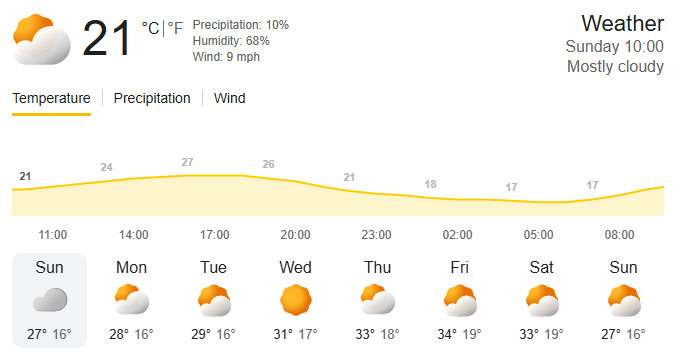
For those that don’t know, 30°C is somewhat unusual for the UK, and counts as a “heatwave”. Now that we have had a few heatwaves that are 30°, talk from green quarters is about heatwaves that are 40°C plus.
The Met Office’s prediction is a little up on Google’s. I do think the MO unfortunately has its fingers on the scales recently. The recent heatwave wasn’t quite what the MO had predicted.

The point is not just that prediction is difficult. Temperature is difficult. It may be possible to explain what the temperature of an object is. But what if the object is an entire city, country or planet, or the air moving over it at 1m… Things absorb radiation from the sun and from their environment differently. An iron object, or the black tarmac of the road will heat up and re-radiate the air around them differently than wood, earth and trees. So to what extent does a city “have” a temperature? Furthermore, the more one records, the more likely it is that one will record some new data point that exceeds any preceding data. And the technology by which temperature is recorded also changes, as does the temporal resolution — i.e sampling rate — of the record. In the past, each record had to be made manually, by reading the temperature from the thermometer, and then recording it in a book. Now, remote stations record data continuously.
All these things confound not just a historical record of ‘temperature’, but also a definition of ‘temperature’. And this complexity is the origin of much climate scepticism, which, among many other things, questions the fidelity of climatic reconstructions from proxies such as tree rings, ice core data, sedimentary deposits, and then the comparison of such synthetic temperature data to contemporary measurements of the resistance of platinum wire, or the infrared emissions of land and microwave emissions of atmospheric oxygen as seen from space.
There is another way to look at the problem though. It is not one that asks whether or not the data that it has been possible to obtain supports standard (i.e. non-alarmist) interpretations of global warming physics and chemistry, or its more alarmist “runaway” climate stories, or rules them both out. It’s one that asks “so what?”
My scepticism of environmentalism emerged around the time of the publication of Bjorn Lomborg’s The Skeptical Environmentalist. One of the claims from the green lobby around that time was that “climate change will be worse for the poor”. To illustrate the point, analysis from the WHO’s 2002 World Health Report found that 150,000 deaths in High Mortality Developing Countries could be attributed to climate change, vs zero deaths in wealthier classifications of countries. Leaving aside the nature of that methodology (which I have written and spoken about a great deal since), it seemed to me very obvious that far from being “the greatest threat facing mankind”, it was therefore one of the most trivial. There are many, much greater problems if attributable deaths is the metric that should drive action. Moreover, if the problem of poverty was eliminated, then the problem of climate change would be eliminated.
Lomborg has done a lot of work in this area, showing how much good could be done through other interventions and adaptation, compared to mitigation by emissions-reduction. For this effort, the most telling response came from the late chair of the IPCC, Rajendra Pachauri, who compared the Danish economist to Adolph Hitler in 2004:
“What is the difference between Lomborg's view of humanity and Hitler's? You cannot treat people like cattle. You must respect the diversity of cultures on earth. Lomborg thinks of people like numbers. He thinks it would be cheaper just to evacuate people from the Maldives, rather than trying to prevent world sea levels from rising so that island groups like the Maldives or Tuvalu just disappear into the sea. But where's the respect for people in that? People have a right to live and die in the place where their forefathers have lived and died. If you were to accept Lomborg's way of thinking, then maybe what Hitler did was the right thing.”
As I’ve argued before, comparisons are everything in politics. And so if the person making a comparison does not have the means within his instrument of comparison to make a distinction between Lomborg and Hitler, then it is very likely that the greater problem lies with the instrument. The chair of the IPCC should have — and could have — brought Lomborg and his analysis into the IPCC’s enterprise. But the chair was resistant to the organisation actually determining what kind of problem climate change is, despite that being what the IPCC was seemingly founded to do.
If the IPCC had determined what kind of problem climate change is, its solutions would open up as technical parameters. This would enable the kind of comparisons that Lomborg favoured. Instead, the global green science and policy apparatus requires only so much data that allows for strategic ambiguity. Too little data, and the critics can claim that science doesn’t have sufficient data to warrant any kind of policy interventions. Too much data, and the problems become solvable, not the basis for an ongoing political order. As the convenor of the UN Environment Programme put it (as told to me by critical historian of the green movement, Rupert Darwall) “the process is the policy.” By ‘the process’, Strong meant the never-ending circus of international conferences.
Such a nebulous political project requires a nebulous conception of ‘nature’ and society’s relationship with it also to be sustained, rather than given tangible parameters by science. This is not unlike the satirical “rigidly defined areas of doubt and uncertainty” demanded by philosophers in Douglas Adams’s The Hitchhikers Guide to the Galaxy, after a supercomputer, Deep Thought proposed a successor (the Earth) to answer the Ultimate Question. Accordingly, a bewildering array of simulations of the planet’s functioning have been offered by scientific organisations in and beyond the IPCC’s orbit — most famously (and deliberately so) those of World Weather Attribution (WWA), who are called on each time the weather seemingly deviates from a norm, to tell us how much more likely that deviation was made by anthropogenic CO2.
This takes us back to those 150,000 benighted souls who are lost from the world’s poorest countries. And it takes us back to the question “so what?”
Does the WWA’s statement of probability make any difference to the lives of the 150,000 and those who follow them prematurely? No.
Would agricultural machinery, abundant and affordable diesel, water and energy infrastructure, transport networks, access to markets, and information technology have made a difference to those lives? Yes.
So who should be compared to Hitler?
In interviewing Andrew Orlowski for my hopelessly delayed film on Net Zero and Ed Miliband (again, apologies, it is coming), he summed up what I’d long thought. Coming from a family of engineers, he explained, he took the claim that 2 degrees of warming would be an existential risk to be a “personal insult”. Expanding, he points out that human civilisations were established across a huge range of environmental circumstances, before even industrialisation and the capacity for social organisation that we have now. Orlowski is right. We should take this personally. WWA’s claims, among others, are a deep insult to our intelligence. They are a grotesque insult to all of humanity.
What is the mechanism by which climate change is going to destroy civilisation? Yes, it’s slightly warmer. But that doesn’t leave us without options — including air conditioning. Yes, weather can be extremely inconvenient, and even fatal for some, where civil planners have not done their jobs. But as I outline in my recent Daily Sceptic piece (copied below), “climate change” is not capable of altering the parameters so dramatically that industrial society can neither adapt, nor even thrive.
My point is about heatwaves. People are going on about them as if temperatures in Europe and the UK were not survivable. But they are. Humans are a tropical species. The most dangerous temperatures for us in Britain — central England, to be precise — therefore occur between September and May through autumn winter and spring, not the summer months. What we in Britain have come to call a ‘heatwave’ are in fact closer to the optimal conditions for human survival. The rest of the year, we need cultural adaptations rather than biology to survive: heating, clothing, shelter, practices, and so on.
But the green story is that we are being moved perilously away from optimal conditions granted to us by Nature. Out of our niche, we are going to be battered by storms, floods, rising seas, winds, heatwaves, droughts…
But surely the answer to these claims is the same as or as simple as the answer to those who claimed that “climate change will be worse for the poor”, and that it already “150,000 deaths per year”: let’s confront poverty then.
The solution to storms is building codes/regulations. The solution to floods is water management infrastructure. The solution to rising seas is sea defences. The solution to gale-force winds is, again, tougher building codes. The solution to heatwaves is air conditioning (i.e. cheaper energy) and working environment regulation. The solution to droughts is again, better water management, desalination (and cheaper energy)…. And on it goes. None of these problems is terminal for society. Extremes could increase tenfold… No ONEHUNDREDFOLD in Britain, in terms of body counts, and no objective analysis could claim that society had become any more more vulnerable to “climate” than it was a century ago.
That is manifestly not a claim that “climate change is not happening”. Nor is it a claim even that “climate change is not a problem”. What it is, categorically, is a broad and general attempt to define climate (changing or not) as a series of tangible problems.
How can different weather become an "existential threat” to the functioning of society, such that glorious summer days become harbingers of doom? The reason is of course green ideology, which resists tangible statements, because it requires Gaia’s wrath to be infinite, and obedience to it to be absolute. Tangible statements are anathema to environmental ideology, which is why Pachauri got so cross with Lomborg that he compared an attempt to help as many people in the world with the attempt to exterminate entire races of people. And that is why greens hate it when you say “it’s just a heatwave - enjoy it or buy a fan".
The claim that society is going to collapse or faces existential threats from slightly difference weather has no scientific basis. Institutional science and individual scientists have failed to confront green ideological hyperbole — likely they are terrified of the gatekeepers like Pachauri withdrawing funds. But we need to push back, regardless, and explain that when greens claim that heatwaves in Britain represent our imminent doom, they are singing from the hymn sheet of a dark and weird bad religion. They have turned safety into danger. All you need to survive hot weather is all that any human, including in prehistory, ever needed: water and shelter. Notice also how difficult greens make even those basics.
The Problem With ‘Extreme Weather’
Each year, the 23-degree tilt of the planet we live on causes seasons to change as it orbits the Sun. We also know that on top of this regime, heat is moderated, and sometimes intensified by particular weather systems, to create ‘heatwaves’. For most of history, people had no explanation for either seasonal change or differences between a season from one year to the next, or even one week to the next. Now we do have explanations for such things, yet some people are still surprised to discover each year that we in Britain, at roughly 53 degrees latitude, occasionally experience weather that some find uncomfortable. Even more remarkably, and despite these explanations, some people think that warmer temperatures are a harbinger of doom. They are ‘extreme weather events’, such voices claim, and they are ‘getting more frequent and intense’, and soon they will rip society from its foundations – just you watch. But what is ‘extreme weather’, and is it really capable of destroying civilisation?
The New Scientist proclaimed that “Europe’s heatwave is the hottest and most humid ever” and “temperatures in western and central Europe would have been virtually impossible 50 years ago”. The claim, of course, originated in the widely-debunked climate propaganda outfit, World Weather Attribution (WWA), which responds to weather events by being the first scientists to ‘estimate’ the contribution of anthropogenic global warming to such events. The problem is that “attribution” is not science, new or otherwise. It’s just games with computer simulations that codify their authors’ ideological presuppositions. Its purpose is to keep the climate narrative alive, with heatwaves supplying the never-ending plot with episodes, like some weird soap opera.
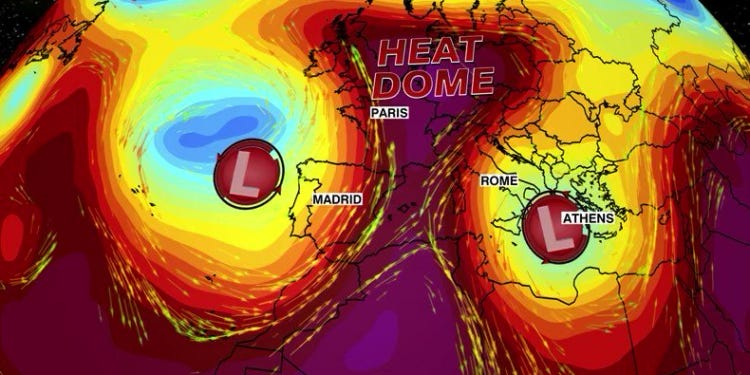
In contrast to such green hyperbole, meanwhile, meteorologists in both social and news media explained that the heatwave over Europe was caused by jet streams forming an ‘omega pattern’ (after the Greek letter), which blocked wind bringing hot air from the south, thereby creating a ‘heat dome’. But that explanation wasn’t enough for some, who needed more drama. Following the outbreak of a wildfire in Derbyshire, arch-Blobber Ben Judah took to X to ask: “Where is the Labour politician seizing this to explain this is climate change and this is why we are doing Net Zero?”
