
Emissions Trading System breakdown
The EU's flagship Ponzi scheme is not as popular as it once was.

I have written a number of articles over the last year expanding on my view that the green agenda is unravelling in Europe faster than it is in Britain. Every time I have written a piece, however, Europe’s two steps forward are followed by a step back. In the article below I point out some more tensions afflicting the EU’s Emissions Trading Scheme (ETS), which Italy is proposing to bypass completely, Germany has recognised as the problem besetting its manufacturers competition with China’s, and France which seems to want to have its cake and sustain it. No sooner had I written it than the European Council proclaimed:
Today, the Council formally adopted the amended European climate law, introducing a binding intermediate climate target, for 2040, of a 90% reduction in net greenhouse gas (GHG) emissions compared to 1990 levels. This new target strengthens the EU’s path towards achieving climate neutrality by 2050 across all sectors of the economy.
I still don’t believe that this is a contradiction — it is Europe that is conflicted. As much as member states want to follow the Council’s direction, national governments are closer to the chaos that such policies unleash for domestic populations and industries. Ursula von der Leyen’s statements about the benefits of her Green Deal, for example are just empty ideological mantras that at best presuppose, despite the evidence, that a green economy is both possible and better than an economy with hydrocarbon energy sources at its centre.
EU member states want to reduce commitments, such as the ETS and the abolition of petrol and diesel cars, and so on, because they are destroying domestic industries. Meanwhile, the UK government, which remains as committed to green ideology as von der Leyen, wants “dynamic alignment” with the EU. Meanwhile, the crisis caused by governments’ distance from publics grows, and will result in governments’ distancing from the EU. the only explanation I can think of for the EU’s persistence in the matter, though it could quite easily terminate the crisis today if it desired, is that an awful lot of big promises have been made to those that can sustain it.
The figures grow starker by the day. And that was before the outbreak of the Iran crisis. Luckily, we are heading into the warmer months. But if the crisis is not resolved in short order, shipments of gas, oil and chemicals such as fertiliser — which the EU and UK, by virtue of the choices they have made for themselves on our behalf, are unable to produce for themselves — may be stuck, and the inevitable will unfold. Meanwhile, the competitive advantage enjoyed on the other side of the widening geopolitical split will increase.
Tensions, tensions, everywhere. Between publics and governments, between governments, between governments and the EU, between Europe and the USA, between emerging geopolitical poles. None of it is good. And it is all worsened here by the utter intransigence of Europe’s political classed that just will not let go of the green dream.
Europe is Finally Waking Up to the Fact That China Has No Intention of Letting Climate Action Harm its Industries
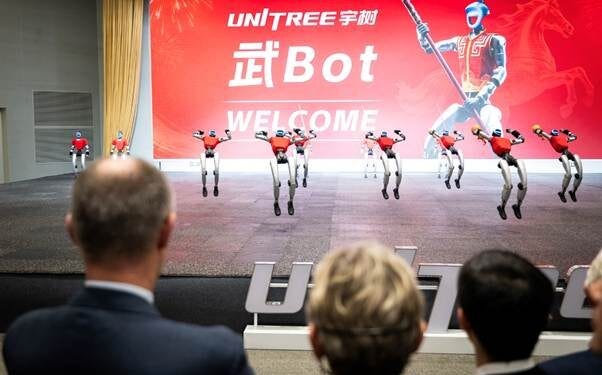
“I’ve seen things you people wouldn’t believe,” said German Chancellor Friedrich Merz on his return from China. No, wait, that was the ‘replicant’ android Roy Batty played by Rutger Hauer in Ridley Scott’s Blade Runner. In no less a tragic scene, however, Merz might just as well have been recounting his experience of galactic travel. He hadn’t seen attack ships on fire off the shoulder of Orion, but he had seen a synchronised robot combat-dance and the eastern industrial rival’s advanced manufacturing capabilities. “We are no longer productive enough,” he told other European policymakers ahead of his trip. “If you come from China, ladies and gentlemen, then you have an even clearer feeling that with work-life balance and a four-day week, prosperity in our country cannot be maintained in the long-run.” In another universe, and not one governed by implausible sci-fi premisses, it could now be Germany hosting impressive displays of robotic prowess.
The Energiewende – high-tech industries powered by Gaia’s Providence – was the less plausible science fiction plotline Germany chose for itself. It turns out that you can’t have nice things if making nice things becomes too expensive a process, and other makers of nice things have lower costs, such as labour and energy. And it turns out that if you don’t make nice things, then you can’t do nice things, such as maintain “work-life balance” and fund public services. For too long, and across Europe, the concepts of values and principles have been estranged from all that has made them possible. Armies of numpty wonks in London, Brussels, Paris, Berlin, Rome and beyond, never stopped to wonder, ‘What is the relationship between those cooling towers and our social-democratic, progressive, liberal outlook?’ Instead, they claimed that the next stage in human development required blowing them up.
