
Badenoch's empty climate gambit
It has been little more than a week since the events that ought to have marked the most dramatic change in UK climate politics. But the bang quickly turned into a whimper.

I was extremely optimistic when, ahead of the Conservative Party Conference, Kemi Badenoch announced that a future Tory government would repeal the 2008 Climate Change Act. As previously stated here, whatever it meant, we could be sure that it marked a sea change in British climate politics, namely, an end to the cross-party Westminster consensus. But a big but remains. The green blob, which one way or another engineered that cross-party consensus, is immensely powerful throughout the West and its governments, intergovernmental agencies and supranational bodies, and of course, in civil society, news media and academia. Many £billions have been spent on divorcing national governments from their publics. Countless £billions more have been invested on schemes to implement policies that transfer wealth from the public to the green blob’s grantors. The idea that it would give up without a fight is implausible.
Accordingly, repealing climate legislation needs policy to be extremely robust. And concomitantly, a party championing such an agenda needs a thoroughgoing critique, not just of climate and energy policy failures, but of climate politics and green ideology. I have been pointing this out since before the election: in order to rescue itself, the Conservative Party needs to evidence contrition, reflection, and a plan of action. And that is because, as has been explained on these pages, the green agenda was at least as much the Conservatives as it was Labour’s. It’s no use blaming Miliband.
Although policy seems fundamental to the business of politics, it is the most superficial aspect. It was, after all, the nominally Conservative government of Theresa May that stole the idea of an “energy price cap” from Ed Miliband, himself leader of the Labour Party, in the 2010s. And there is the issue of the consensus. If a Party has no basis in principles, philosophy, ideology — call it what you will — that preclude it from merely absorbing the putative opposition’s policy agenda, then what in effect is being contested by democratic politics? Neil Kinnock said it best this week:
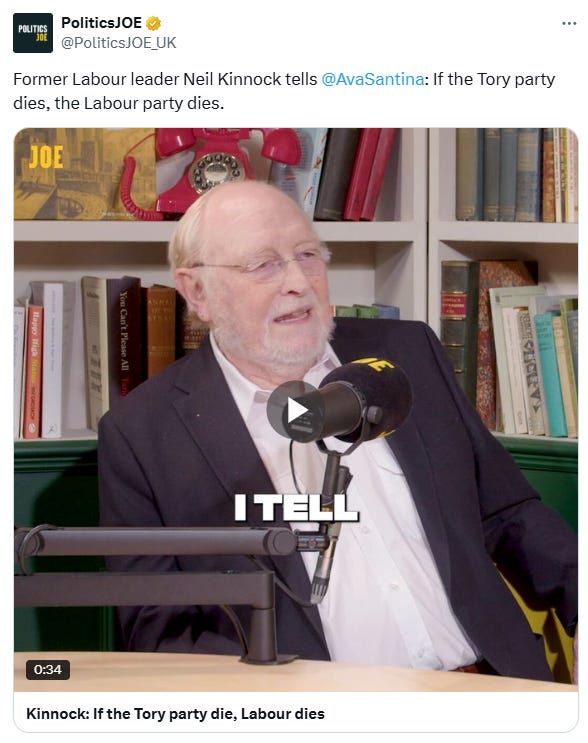
Conservative and Labour, argues the long-former leader of the latter party are wholly dependent on each other. One offers what Kinnock calls “democratic socialism”, the other a right-of-centre market liberalism of some kind. Though he frames this as a “contest of ideas”, it is, or it became, the opposite. It limited democratic representation and debate. It put far reaching policy decisions out of the reach of ordinary people. And that process of undemocratisation, parallel to deindustrialisation and economic stagnation, was accelerated by the putative urgency of the ‘climate crisis’. Without debate, and without contested views, Westminster atrophied, and green ideological rot established itself across the entire British political and cultural establishment.
And this is why the Conservative Party’s minor U-turn on climate policy isn’t a sufficient departure from green politics — the terminal point of the Labour-Conservative consensus was their closing ranks against the public, and neither seem to be able to depart from it. There’s just too much weight and too much speed for a U-turn — neither party can change direction without toppling over.
Keep reading with a 7-day free trial
Subscribe to The Net Zero Scandal to keep reading this post and get 7 days of free access to the full post archives.